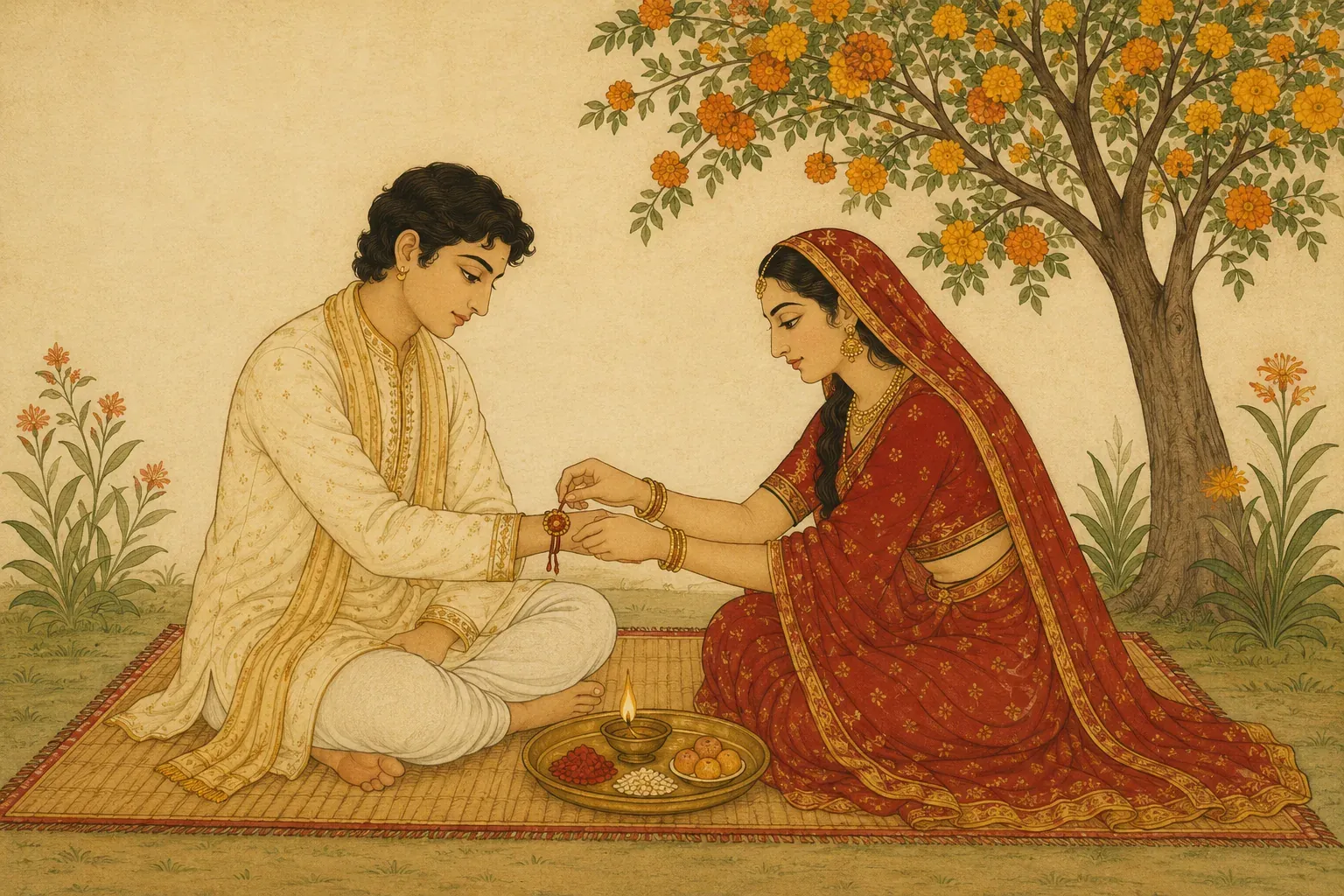
Why Raksha Bandhan is celebrated
Every year, on the full moon of the month of Shravana, millions of people tie a piece of thread around someone else’s wrist. The thread costs nothing. It frays within a week. And it carries an obligation that is expected to hold for a lifetime.
That gap — between how little the object is worth and how much it is meant to mean — is the whole festival.
What the name actually says
Raksha Bandhan is Sanskrit, and unusually for a festival name it is completely literal. Raksha is protection. Bandhan is a tie, a binding, a bond. Put together: the bond of protection.
Not the festival of brothers and sisters. Not the festival of gifts. The name describes an object and what that object is for.
This matters because the name is older and broader than the custom most families practise today. A raksha was a protective thread, and tying one was something you did before a journey, before a battle, before anything whose outcome you could not control. Who tied it to whom was not fixed.
The older, wider custom
Long before it became a sibling festival, the protective thread had several lives that are still visible if you look for them.
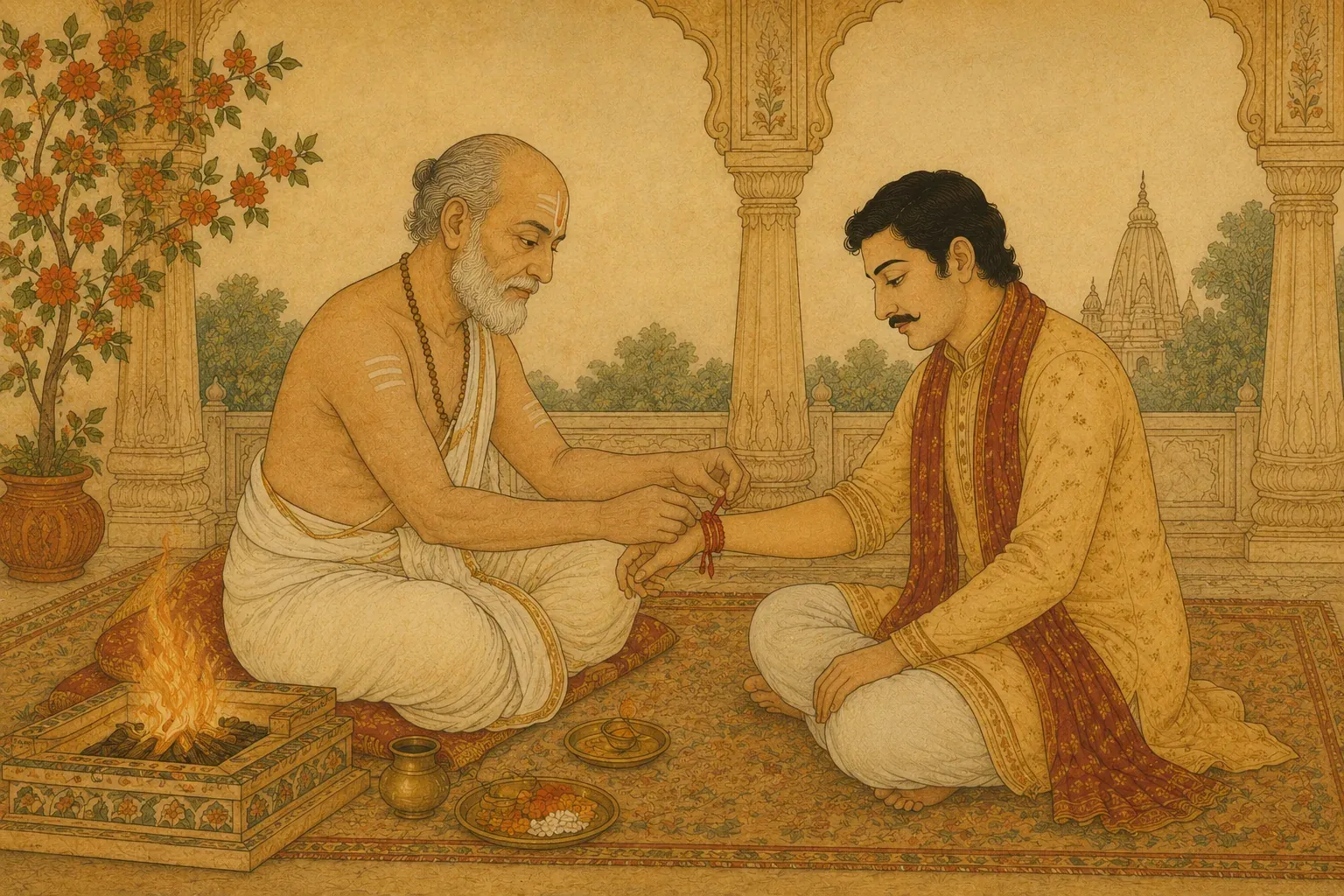
A priest ties it to a patron. In the rakhi that a purohit ties around the wrist of a household he serves, the direction of protection runs the other way — the blessing is given by the one tying, and no sibling relationship is involved at all. Many families still receive this thread on the same day.
It is tied before danger. The idea of a thread as a shield appears again and again in Indian texts and practice: something worn on the body as a standing prayer for the person wearing it.
Whole regions attach it to something else entirely. On the very same full moon:
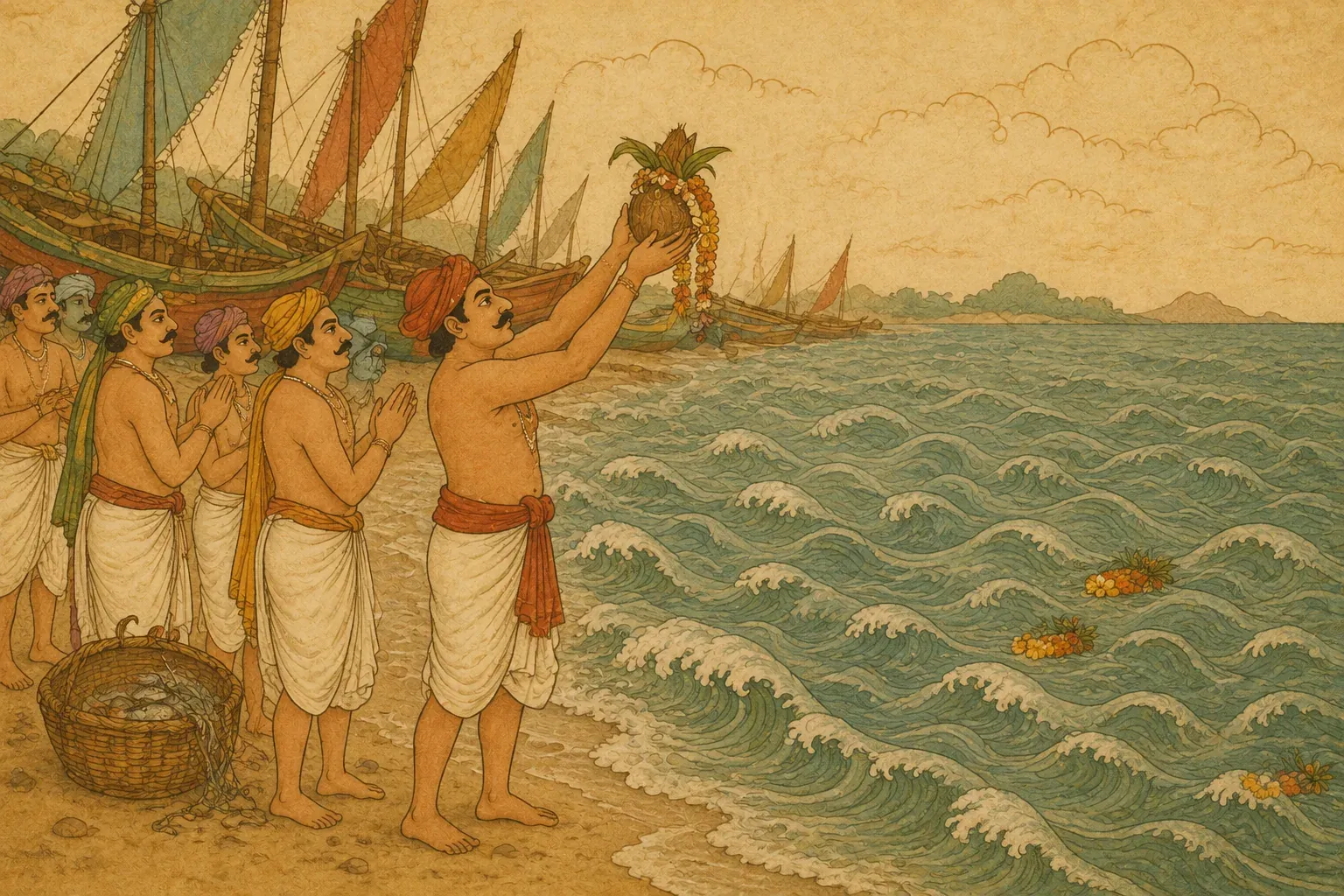
- In coastal Maharashtra it is Narali Purnima, when the fishing community offers a coconut to the sea and the monsoon fishing season formally reopens.
- In parts of Odisha and eastern India it is Gamha Purnima and Jhulan Purnima.
- In much of the south it is Avani Avittam, when the sacred thread is changed.
- In Nepal and among Nepali communities it is Janai Purnima, and the protective thread tied on the wrist is the raksha bandhan in the older sense of the phrase.
None of these are versions of the sibling festival. They are separate observances that happen to share a full moon — and in a great many families, both are kept on the same day without any sense of contradiction.
How it became a brother–sister festival
The narrowing to siblings is real, and it is the dominant form now across north and western India. Several strands fed into it.
The stories did a lot of the work. The best known is Krishna and Draupadi, in which a torn strip of cloth bound around a wound creates a debt that is repaid years later at the worst possible moment. Another is the story of Bali and Lakshmi, where a thread tied on a king’s wrist is used to claim a boon. These are not histories, and they do not agree with each other. What they share is a shape: someone gives a thread, someone incurs an obligation, and the obligation is honoured when it is genuinely inconvenient.
There was also a practical reality behind it. In a society where women typically married out of their natal village, the tie to a brother was a woman’s one durable claim on her birth family — a right to be visited, heard, and helped. An annual ritual that renewed that claim publicly was not sentimental. It was infrastructure.
Something of that survives in the details. The sister travels, or the rakhi travels by post. The brother gives neg — money placed in her hand. The formality of it is the point: a promise made in front of the family is harder to quietly drop.
What the ritual is saying
Strip the thali back and the exchange is very simple, and it goes in both directions.
She ties the thread and prays for his wellbeing. He accepts it and undertakes to stand by her. She gives the blessing; he gives the guarantee. Neither half works alone, which is why “sisters ask brothers for protection” is a poor description of what is happening — it deletes the half where she is the one doing the giving.
And the thread is chosen badly on purpose. Nothing about it is durable. A promise that needed a strong object to hold it would not be much of a promise; this one is expected to survive the object rotting off the wrist within the month.
Who it is for now
The custom has kept widening, quietly, without anyone announcing it.
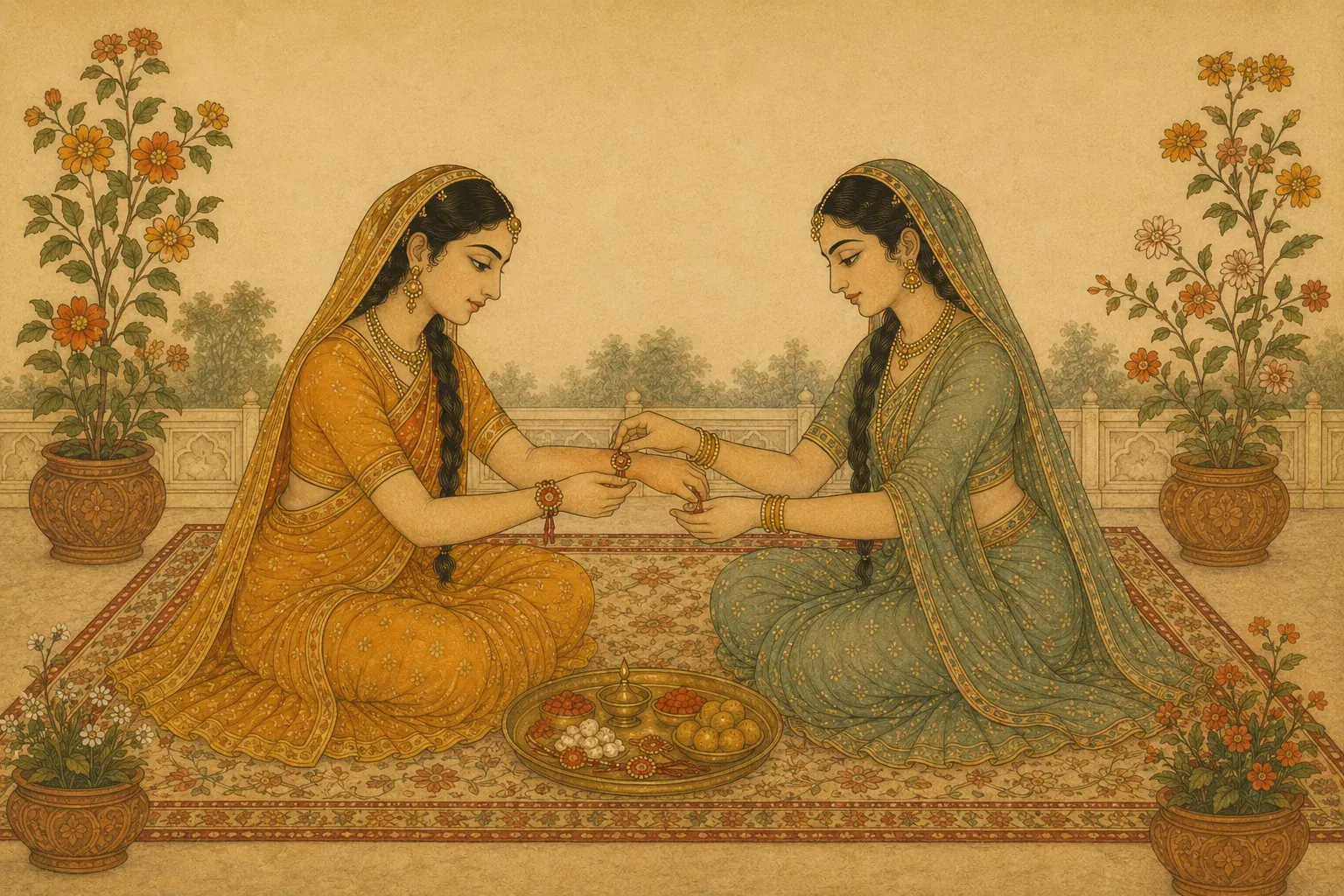
Sisters tie rakhi to sisters. Cousins tie it to cousins. It goes to close friends, to a bhabhi — the lumba rakhi on her bangle — to people who are family by choice rather than by birth. During the freedom movement, Rabindranath Tagore used a mass rakhi-tying in 1905 Bengal as a public statement that a community being split along religious lines refused the split.
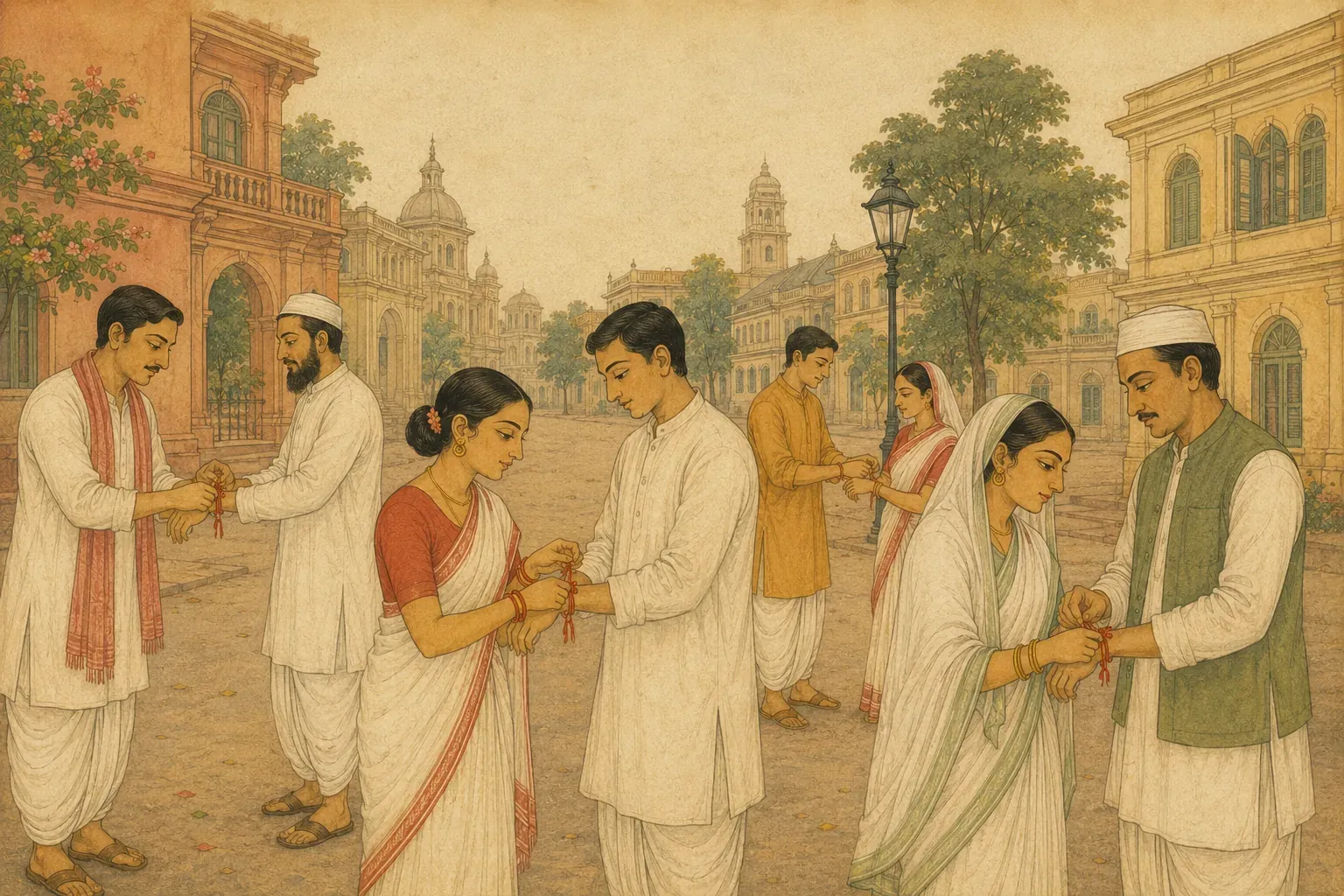
All of which is closer to the original meaning than the narrow version is. The thread was never really about who your brother is. It was about naming, out loud and in front of everyone, the people you have decided to be responsible for.
Read next: Krishna and Draupadi · Raksha Bandhan 2026: date and timing · The complete ritual, step by step
आम सवाल
- What does Raksha Bandhan mean?
- Raksha Bandhan is Sanskrit for 'the bond of protection'. Raksha means protection and bandhan means a tie or bond, so the name describes the object at the centre of the festival: a thread tied as a promise of care.
- Why do sisters tie rakhi to brothers?
- A sister ties the thread as a prayer for her brother's wellbeing, and he responds with a promise to stand by her. The exchange is mutual rather than one-directional — she gives the blessing, he gives the undertaking.
- Is Raksha Bandhan only for brothers and sisters?
- No. The older meaning of the raksha thread was general protection, and it is still tied by priests to patrons, by sisters to sisters, to cousins, to friends, and in some regions to soldiers and to trees. The brother–sister form is the most common one today, not the only one.
- What is the significance of the rakhi thread?
- The thread is deliberately ordinary — cotton or silk, worth almost nothing. Its value is entirely in what it represents, which is the point being made: the obligation is real even though the object holding it is fragile.