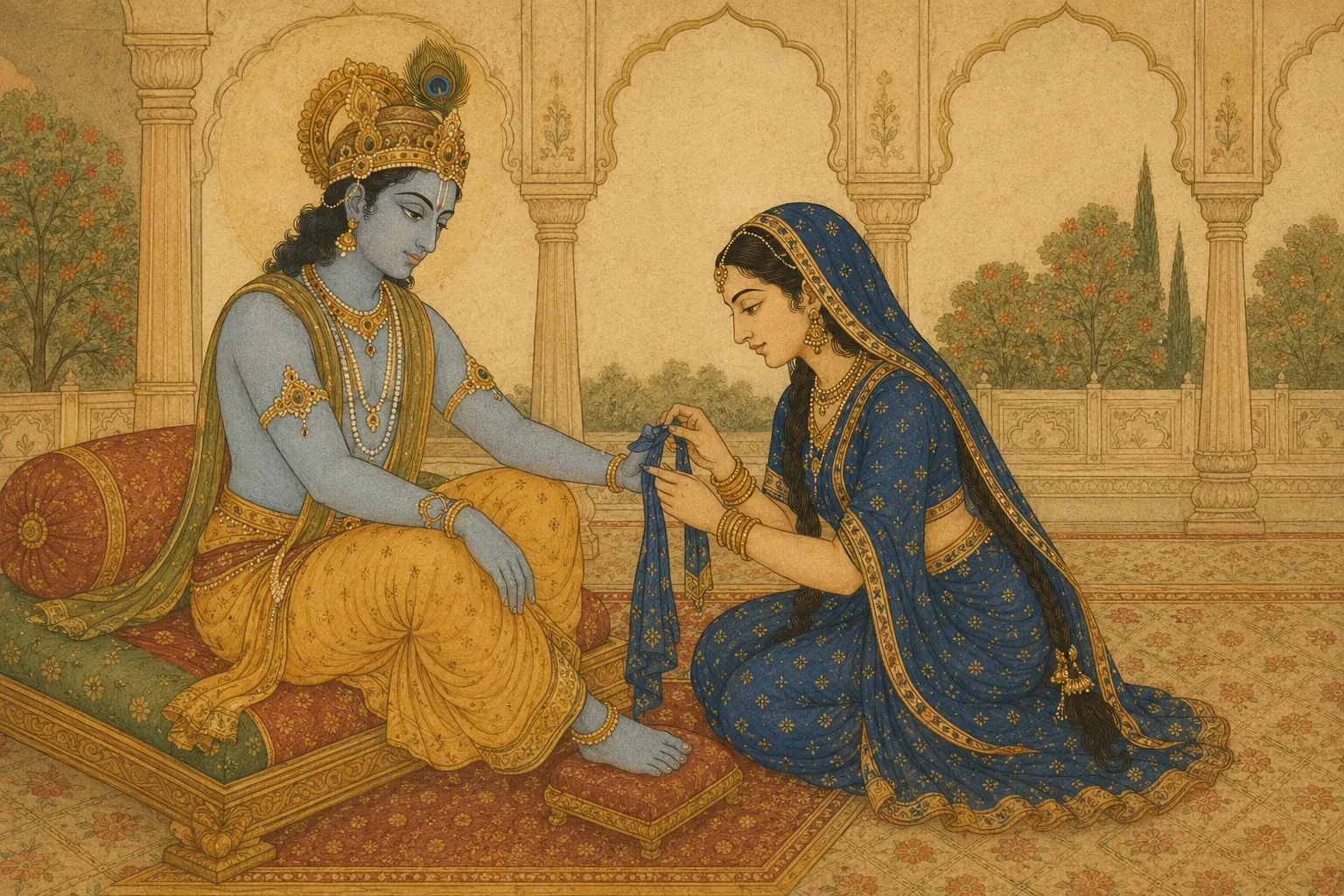
Krishna and Draupadi
Of all the stories attached to Raksha Bandhan, this is the one people actually tell. It is also the one most often repeated with a confidence the sources do not quite support — so it is worth separating the two.
The story as it is told
Krishna is at the court of Yudhishthira for the great sacrifice. Shishupala, who has spent his life insulting Krishna, exhausts the hundred offences Krishna had promised to forgive. Krishna releases the Sudarshana chakra and Shishupala is killed.
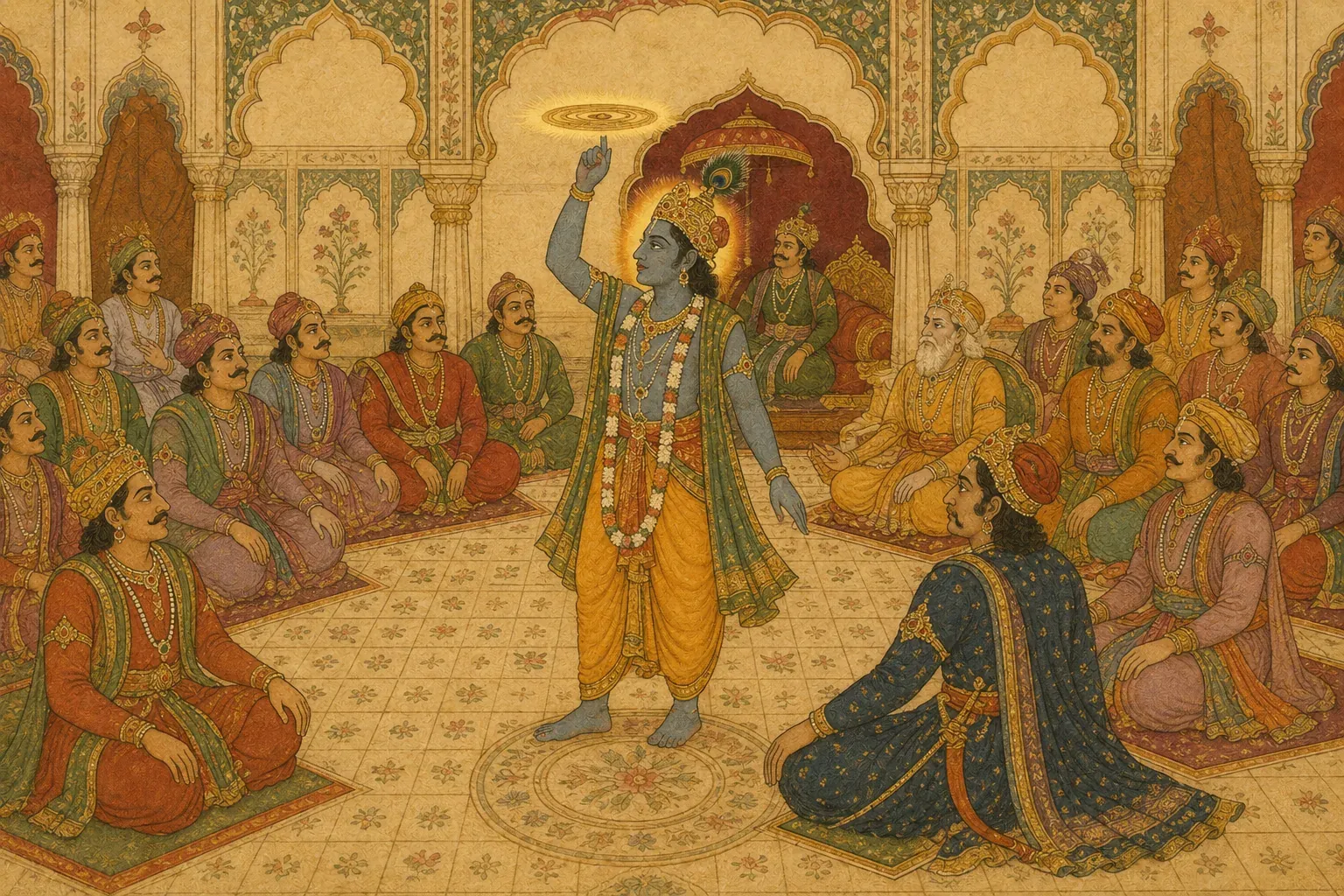
In the popular telling, the discus returns and Krishna’s finger is cut. Blood runs. The court moves — someone goes for cloth, someone for bandages.
Draupadi does not go anywhere. She tears a strip from the end of her sari and binds his finger with it.
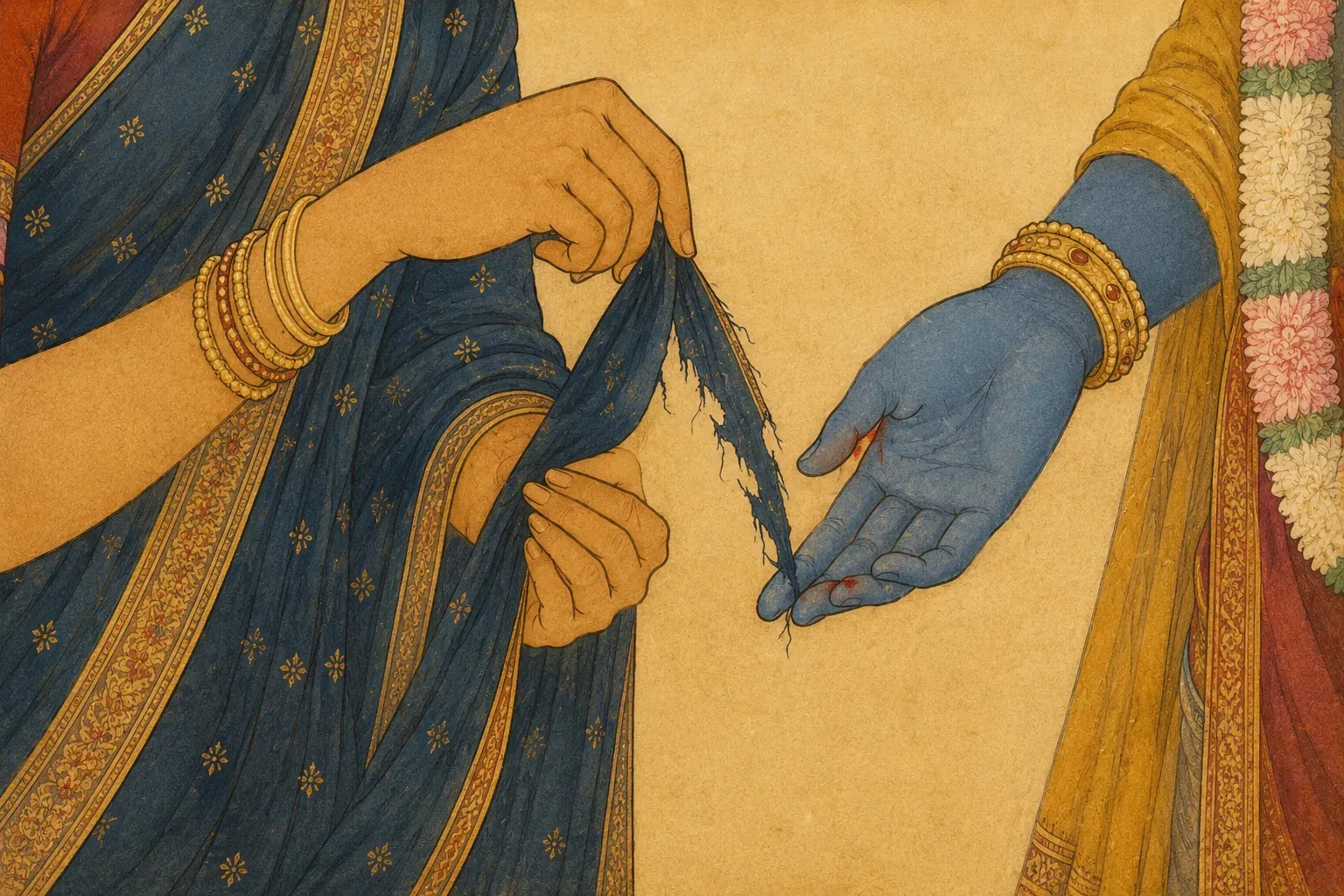
It is an ordinary act. It costs her a ruined garment and a moment of not thinking about it first. She does not ask for anything, and there is no suggestion she expects the moment to be remembered.
Krishna remembers it anyway. In the story he tells her the debt will be repaid.
The repayment
Years later, Yudhishthira gambles away his kingdom, his brothers, himself, and finally Draupadi. Dushasana drags her into the assembly hall by her hair and begins to pull at her sari in front of the entire court. Every man in the room who could stop it — her husbands, the elders, the king — sits still.
She calls for Krishna.
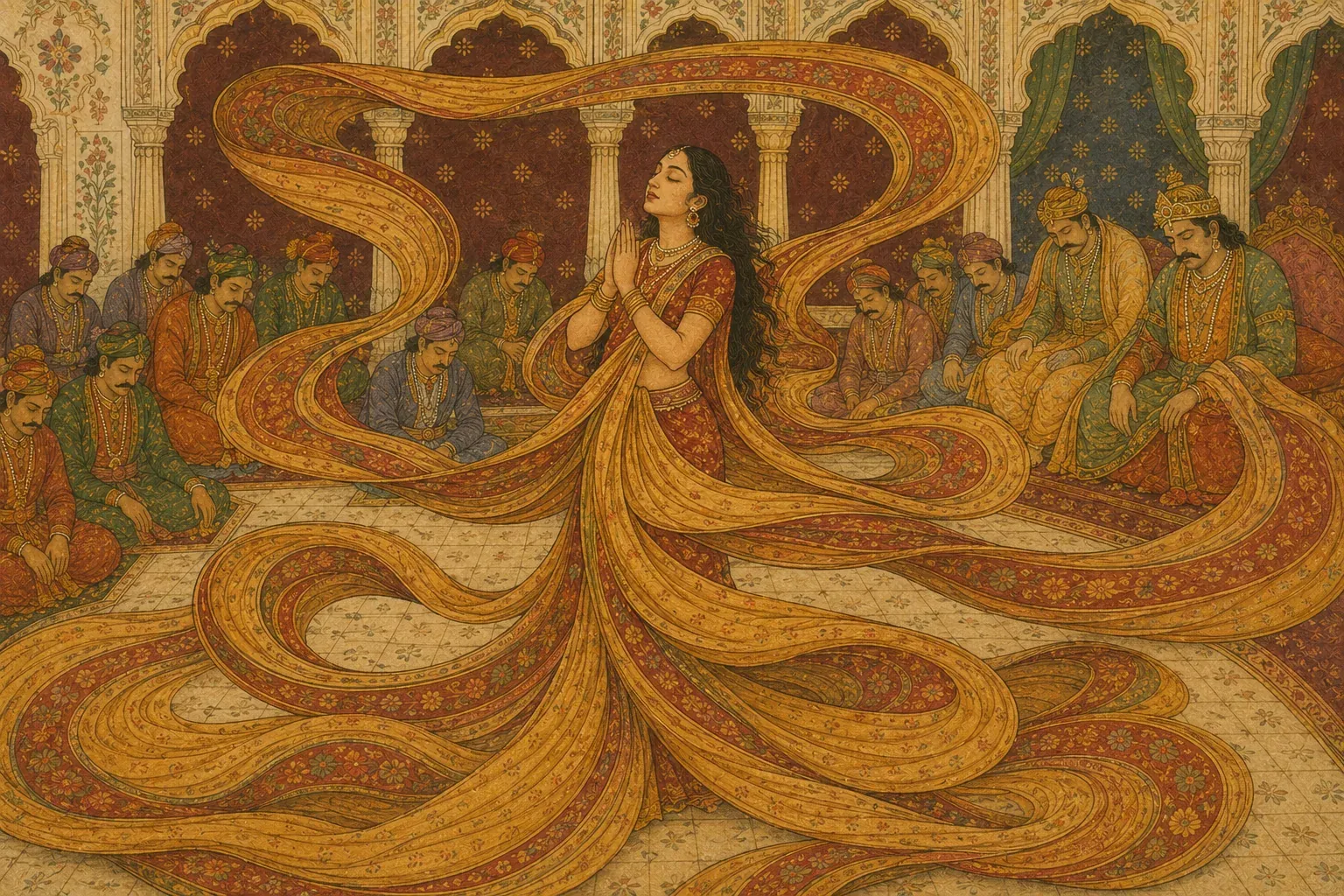
The cloth does not end. Dushasana pulls until he collapses from exhaustion, and the sari is still there.
The symmetry is what makes it stick: she gave him a strip of cloth, and he gave her cloth without end. She had protected his dignity with a torn piece of her garment; he protected hers with an infinite one.
What the epic actually contains — and what it does not
This is where care is needed, because the story is repeated across the Indian internet as though it were a chapter of the Mahabharata with a verse number.
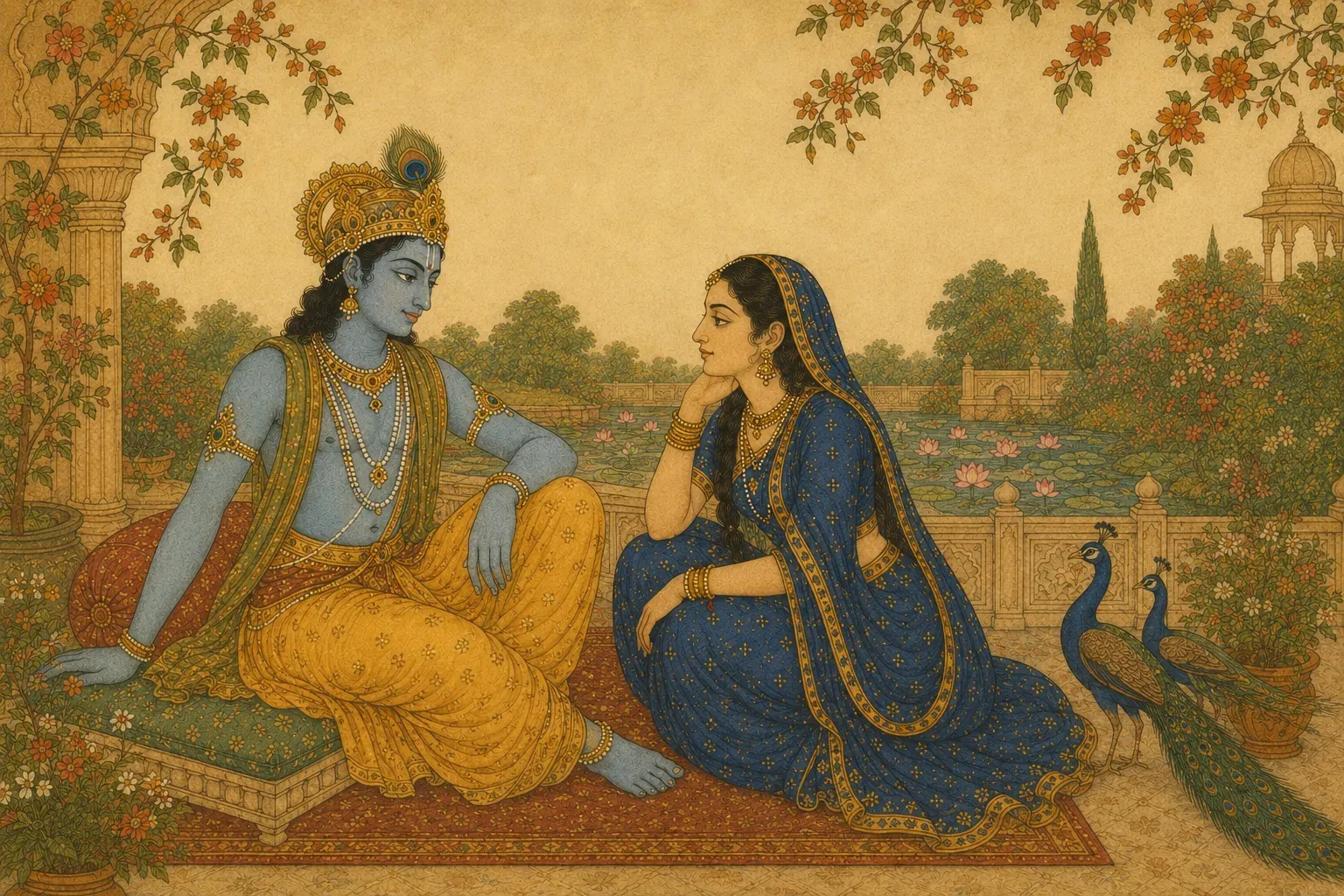
In the epic: Shishupala’s death at the sacrifice is there. The deep friendship between Krishna and Draupadi is there, and it is central — he calls her sakhi, friend, and she calls on him as one. The disrobing in the court and her rescue are there, and they are among the most important passages in the whole work.
Not in the critical edition: the specific scene of Draupadi tearing her sari to bind Krishna’s bleeding finger. It appears in later retellings, regional versions and devotional literature, and from there into everyday speech — but it is not how the epic itself narrates the origin of the debt.
Also worth saying plainly: the Mahabharata does not present any of this as the origin of Raksha Bandhan. That connection is made by tradition, looking back, because the shape fits.
None of which makes the story worth less. It makes it a legend rather than a report, which is a different and perfectly respectable kind of true. It is simply not history, and there is no reason to pretend otherwise.
Why this story and not another
There are several rakhi legends. Bali and Lakshmi is older in some tellings. Indra and Sachi is the one closest to the original meaning of a protective thread tied before a battle. Yama and Yamuna is the one that makes the sibling bond explicit.
This one wins because it is the least sentimental.
Draupadi is not a little sister asking for protection. She is a queen, and in the first scene she is the one giving. Krishna is not obliged to her by blood — they are not siblings, and the entire relationship is chosen. The debt is created by a small act nobody asked for, and it is honoured at the exact moment when honouring it is hardest and everyone else in the room has decided not to.
That is a much sharper account of what a rakhi is supposed to mean than “a brother protects his sister.” The thread does not create the obligation. It names one that somebody already decided to accept.
The line worth keeping
The version usually quoted has Krishna saying that each thread of that torn cloth was a debt he would repay.
Whether or not he said it, it is the correct reading of the festival. Nobody ties a rakhi because the thread has power. They tie it because saying the thing out loud, in front of the family, once a year, makes it harder to quietly stop meaning it.
Read next: Why Raksha Bandhan is celebrated · The complete ritual, step by step
आम सवाल
- What is the story of Krishna and Draupadi on Raksha Bandhan?
- In the popular telling, Krishna cuts his finger and Draupadi immediately tears a strip from her sari to bind the wound. Krishna treats the act as a debt, and repays it years later by protecting her when she is humiliated in the Kaurava court.
- Is the Krishna and Draupadi rakhi story in the Mahabharata?
- Partly. The Mahabharata contains both the friendship between Krishna and Draupadi and the episode in the court where she is protected. The specific detail of Draupadi tearing her sari to bind Krishna's finger is not narrated in the critical edition — it belongs to later popular tradition.
- Did Draupadi tie a rakhi to Krishna?
- Not in the sense of the modern festival. The story describes a strip of cloth torn in an emergency to stop bleeding, not a ritual thread tied on a festival day. Tradition later read it as the first rakhi because the shape of the exchange is the same.
- Why is this story told at Raksha Bandhan?
- Because it makes the point of the festival unusually clearly — the thread is worthless, the giver expects nothing, and the debt is honoured anyway when it costs the most to honour it.